
Hosting
Starter Hosting
For a personal site, brochure site or first business website.
£2 /month
- 1 GB storage
- 50 GB bandwidth
- SSL and daily backups
- 24/7 support
Everything your business needs to be online.
For small and growing businesses that want their website, domain and email handled by one team.
UK offers
Straightforward entry points, with a written scope before any custom work begins.
Hosting
For a personal site, brochure site or first business website.
£2 /month
Most capable
More capacity for busy sites, multiple services and growing teams.
£8 /month
Domains
Registration with managed DNS support and migration help.
£5.75 /year
Website design
A responsive, conversion-focused website planned around your business.
Fixed quote
One accountable team
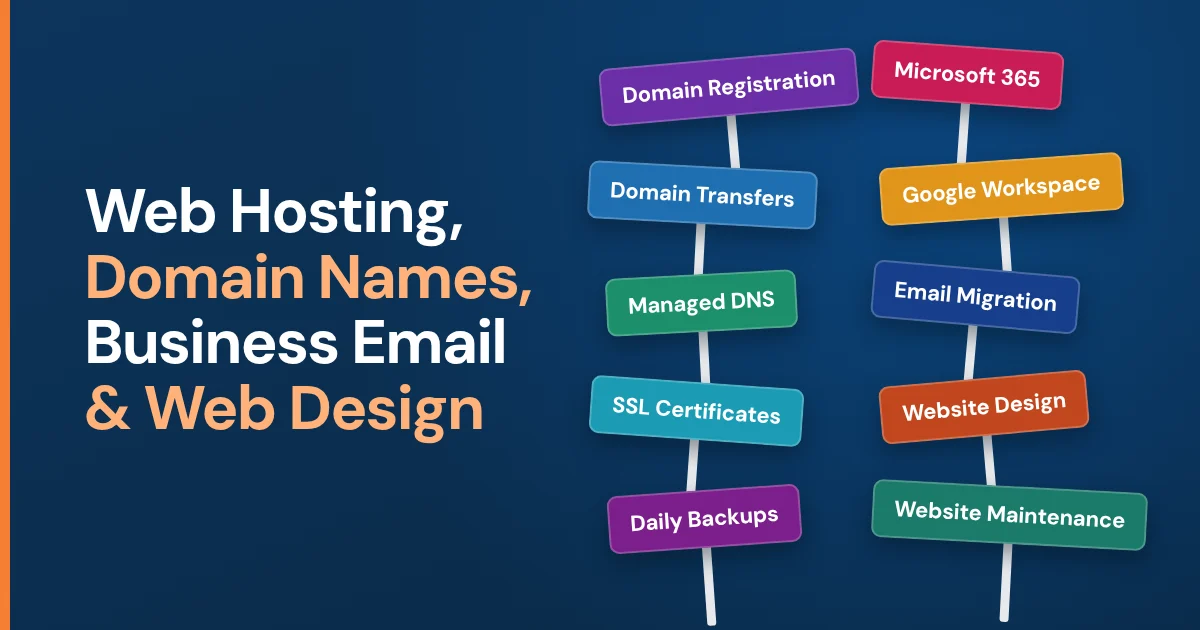
We can host the stack, build the site, improve search visibility and keep business email working properly.
Mailboxes on your own domain, authenticated properly, on the platform that fits how you work.
Explore Business Email →Responsive business websites, landing pages and e-commerce builds.
Explore Website Design →Updates, security, backups and day-to-day technical help.
See Maintenance →Technical, content and local search work measured against useful enquiries.
Explore SEO →SPF, DKIM, DMARC and reputation fixes across Microsoft 365, Google Workspace and other platforms.
Fix Deliverability →Campaigns, templates and lifecycle automations that support revenue.
Explore Email Marketing →Integrations and workflows that remove repetitive operational work.
Explore Automation →Shared vs cloud vs VPS hosting compared → · Professional vs DIY websites compared →
Availability and registration pricing are confirmed in the secure client portal.
Type a name above to see it on each extension.
Search, register, and have the domain live on your own account the same day.
Explore →Mailboxes that carry your name, set up so they authenticate correctly from the first send.
Licensing, mailbox setup, and the DNS authentication that goes with it.
Explore →See business email plans and pricing → · Google Workspace vs Microsoft 365 compared →
Run a check before you talk to anyone. No account, no email address.
No. We can work with your existing provider, although hosting and ongoing maintenance are available when you want one accountable team.
We provide a written scope and fixed quote after the consultation. Third-party costs are listed separately so there are no hidden extras.
The domain name is the address people type; hosting is the server space the site actually lives on. They can be bought separately or together, and we register domains in your own name so ownership never sits with a supplier.
The domain has to be unlocked at the current registrar, an authorization (EPP) code released, and the transfer accepted at the new one. We check the expiry date, the transfer lock, and every service currently pointed at the domain before anything moves.
We build and test the site on the new host first, then move DNS once it matches. Record lifetimes are lowered ahead of the switch and email is checked alongside the site, so downtime is kept to a minimum rather than discovered afterwards.
It depends on page count, content readiness and how many approval rounds are needed. The schedule is agreed in the written scope before work starts, with milestones along the way. Content is usually the slowest part, so a content plan is agreed at the start.
You do. Domains are registered in your name, and code, content and accounts are handed over at the end of the project. Nothing is held back to keep you on a retainer.
Core, plugin and dependency updates, security patching, uptime monitoring, backups, and fixes when something breaks. Maintenance keeps a working site working — rebuilds, migrations and new features are scoped separately.
Technical fixes can move within weeks; content and authority work compound over months. We agree a keyword map and a prioritized roadmap up front, then report on what changed, so progress is visible before rankings move.
No, and anyone selling a guaranteed position is selling something they do not control. Search engines decide rankings. What we commit to is a written scope, a prioritized roadmap, implementation against the agreed keyword map, and reporting that shows what changed and where the next work belongs.
Yes. SPF lists who may send for the domain, DKIM signs the message, and DMARC tells receiving providers what to do when a message fails those checks. Without all three, mail from the domain is easier to spoof and more likely to be filtered.
Warm-up raises sending volume gradually on a new domain or mailbox, so receiving providers build a reputation record instead of seeing a cold spike. How long it runs depends on the volume you are building toward — readiness is set against your planned send rate, not a fixed calendar.
No — and be skeptical of anyone who does. Inbox placement is decided by the receiving provider. What we control is the technical and reputation side: authentication, DNS, sending setup, warm-up, list hygiene and content signals. We diagnose the real failure points, fix them, and report on what changed.
It depends on the jurisdiction and on how the list was built; the rules differ across the UK, EU and US. We run email programs to lists that have opted in. For cold outbound we recommend separate sending infrastructure so it can never affect your main domain, and we are happy to advise at consultation.
Yes. We handle licensing, mailbox migration, DNS authentication and deliverability work across both platforms, supplied and supported by us rather than left to you to manage.
It removes repeated manual steps — routing enquiries, drafting replies, moving data between systems, producing reports. We map the workflow first, automate the parts that are stable, and leave a human decision point wherever judgment is needed.
Tell us what is not working or what you want to build. We will give you a clear next step.
Request a Free Consultation