
Hosting Maintenance Service
A hosting maintenance service covers the server and the site together. When a plugin update and a server setting disagree, the same engineers fix both instead of passing you between two suppliers.
Website Help and Support for Lead-Driven Businesses
Updates, backups, security and responsive technical help for Australian businesses that need their website looked after.
Share the goal or problem. We will reply with the right next step and a written quote.
Website maintenance is the routine work that keeps a website secure, fast and functioning: software updates, backups, uptime and security monitoring, performance care and content changes. Done on a monthly rhythm, it prevents the outages, security incidents and slow decay that cost a business leads and revenue. The same applies to sites produced by AI website builders: they ship real code, and that code ages like any other.
Last reviewed: 21 August 2026
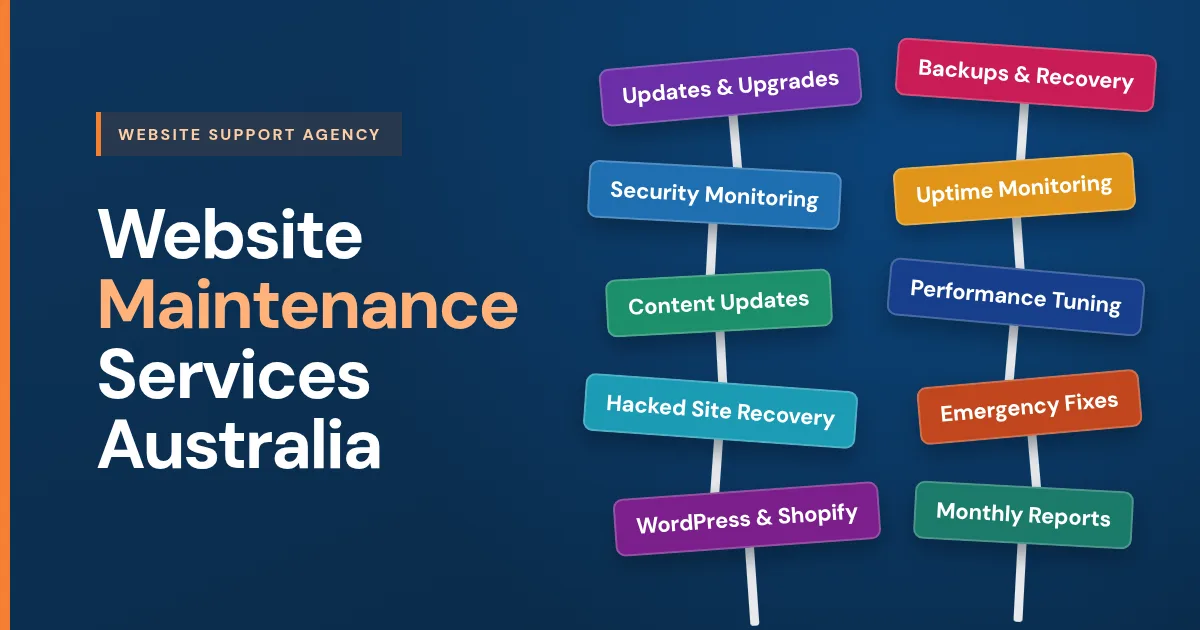
The website maintenance service works wherever the site is hosted. For businesses that also want the hosting looked after, managed hosting can be added to the maintenance plan, so one team, one queue and one invoice stand behind the server as well as the site.
A hosting maintenance service covers the server and the site together. When a plugin update and a server setting disagree, the same engineers fix both instead of passing you between two suppliers.
Managed hosting with SSL and platform backups, plus the maintenance plan on top: updates tested before they go live, off-site backups, uptime and security monitoring, and your content changes.
When hosting is added, hosting and maintenance are quoted together in writing before anything starts, and billed by one company that carries the liability for both.
What the work covers
We manage agreed software, plugin and dependency updates with sensible checks.
Backups and documented recovery steps reduce avoidable downtime.
Ongoing support gives the team a dependable route for site improvements.
Website maintenance packages are sold as fixed monthly plans, not hourly work, and the starting price for each is below. The fixed-price quote comes in writing at the free consultation, before any work starts — no hourly-billing surprises, no scope creep.
from USD 99 / month
The baseline that stops a site drifting: updated, backed up, and watched.
from USD 249 / month
For sites where content moves regularly and speed has a commercial cost.
quoted to scope
For portfolios, and for sites where the response terms need to be written down.
Third-party costs are passed through at cost: hosting upgrades, premium plugins, premium email platforms, domains. They are listed transparently in every quote. Clients often start with a single project and grow from there — no long-term commitment required. Full pricing.
Maintenance is a cycle, not a call-out. Every month runs the same five passes over your site, in the same order, so nothing depends on somebody remembering.
Pass 01
Website updates are the routine releases: WordPress core, themes, plugins, and dependencies, applied each month on a staging copy first and pushed to live during low-traffic windows. If anything breaks, the site rolls back to the daily backup immediately, so an update becomes a routine event rather than a gamble on a Tuesday afternoon.
Website upgrades are the bigger steps that monthly updates never take on their own: a PHP version upgrade before the host ends support for the old one, a major WordPress or WooCommerce release, or a new React or Next.js version on a custom or AI-built site. Each upgrade is tested against the site’s theme, plugins, and third-party integrations before it goes live, because compatibility conflicts show up in the combination rather than in any one component. Where an upgrade would mean rebuilding templates, that work is scoped and quoted before it starts.
Hosted builders such as Wix and Squarespace patch their own platforms, so there the work is app, integration, and settings review rather than code-level upgrades.
In this pass
Pass 02
Automated full-site backups run daily, files and database together, and are stored off-server, so a restore never depends on the same machine that just failed. Every update and upgrade in Pass 01 uses the latest backup as its rollback point.
Website error recovery covers the ordinary failures: a faulty plugin, an incompatible script, an out-of-date integration, or a change somebody made on Friday and cannot undo on Monday. The site goes back to the last good backup first, and the fault is then fixed on staging rather than on the live site.
Hacked website recovery is a separate service, quoted when it is needed rather than included in the monthly plan. It follows the same order: the site is restored from the last clean backup, the plugin or theme the attacker came in through is updated or removed, and the site is scanned again before it is treated as clean. On an e-commerce site, checkout is tested before trading resumes. A hacked site is still treated as an emergency, with a response within an hour during business hours.
In this pass
Pass 03
24/7 uptime checks mean that if the site goes down, the team knows before you do and can start fixing it. Security monitoring runs continuously alongside it: malware scanning, firewall management, and rapid response to security alerts.
Most maintenance failures are not dramatic. They are a slow drift nobody is watching. Monitoring is what turns that drift into a ticket instead of a customer complaint.
In this pass
Pass 04
Ongoing speed optimisation, image compression, caching, and Core Web Vitals improvements stop the site quietly getting slower every time something is added to it.
Performance movement is part of the monthly report, so a slower page shows up as a number rather than a feeling.
In this pass
Pass 05
Content management support keeps the site in step with the business without anyone on your side having to learn the CMS. Need a copy change, image swap, or new page? Send it over and it is handled, usually the same day, within the monthly content allowance on Growth plans and above.
On e-commerce sites that includes product changes: new products, galleries, descriptions, and prices. Images are compressed as they go up, so new content does not undo the performance work in Pass 04. Content updates also cover the details that quietly go stale: old prices, opening hours, contact details, and broken links.
Copywriting for new content, CMS login and user-access fixes, and training for the people who edit the site are available as separate services. Larger work, such as new page templates, redesigns, or content beyond the allowance, is quoted in writing before it starts.
In this pass
Why TK WebHosts Australia
The recommendation is shaped around your market, budget and existing systems—not a generic service bundle.
Related services
Fast, managed website hosting with SSL, backups and migration help for Australian businesses.
Explore service →Domain registration in your own name. Buy a domain name, transfer an existing one, and get practical DNS support for Australian organisations.
Explore service →Conversion-focused websites for Australian businesses, planned around trust, search visibility and useful enquiries.
Explore service →Questions
Yes, as a separate service rather than part of the monthly maintenance plan, quoted when it is needed. A hacked website is restored from the last clean backup, the plugin or theme the attacker came in through is updated or removed, and the site is scanned again before it is treated as clean. It is treated as an emergency: a response within an hour during business hours, longer outside them.
Yes. Custom work starts with a clear recommendation, scope and price in writing.
Usually. We assess the current platform and recommend keeping, improving or replacing it based on evidence.
Yes. Your enquiry, content, pricing context and service route remain inside the Australia site.
A maintenance plan that quietly absorbs project work is a plan that stops being predictable. Here is the line, stated up front rather than discovered on an invoice.
None of this is a refusal — it is a different line on the quote. Third-party costs are passed through at cost and listed transparently in every quote, and larger work gets a fixed price in writing before it starts. No hourly-billing surprises, no scope creep.
Tell us what is happening now and what a good result would look like.
Request a Written Quote